Nurturing Nature Through Wonder: Part 3

There are hundreds of ways to nurture nature, and let me suggest the first two of four.
            The first area is to wonder out in nature.  These are wow experiences.  I was leading a
(photo by Brocken Inaglory)
multigenerational bird tour once in New Mexico with one of our congregations there, and the children were out of their daily routine, and were perhaps a bit hesitant, especially Billie. His mother had a cocaine habit, and he was born addicted to cocaine and had issues with connecting and resonating with others.. We had come across a field full or snow geese, bright white in the sun. Suddenly they all took to the air, their wings vibrating in the very depths of our body and ancestral knowing. The children transformed, they came alive, were pure joy and connection, especially Billie who jumped, danced, cried out, and ran to his grandparents to be close to them, to be held, to connect, and to share in that wonder together.
            Nature is full of unexpected and surprising events that we cannot foresee, and this is good for us.  James Austin, a neurologist, encourages us to have nature experiences because they help integrate our neurological processing and contribute to mindfulness and living in the present moment with attention and gratitude. He particularly suggests looking up, and gives many examples of how this can wire us for presence, including an event that happened to me years ago.
    
        I was out walking in Guatemala studying parrot nests, and my guide was a local Guatemalan. We weren't seeing many birds and so we began to talk.  He wanted to tell me of his love of Jesus and Mary, and I put up my guard a little bit, unsure if he was proselytizing me or expecting something from me I could not give.  I was disconnecting and distancing myself from him mentally, when we came up to the forest's edge where the sun was just rising over the tree tops in a shroud of misty fog. Suddenly a loud flock of parrots burst forth from the tree canopy. Before I knew what happened, I was on my knees in the grass, weeping. I had been so startled with awe and beauty, I just fell. Afterwards I was a little embarrassed, but more than anything I had a sudden clarity and connection to humanity and the world. I knew that when people said words like Mary and Jesus, it was like when I said birds and trees. That experience was part of moving towards things spiritual, towards beauty, towards service, and towards an ease around religious differences, for I saw the wonder moving beneath it all.
(photo by Eric Kilby)
            Dr. Austin says my experiences were not usual.  Indeed in another study the researchers asked students to gaze up at trees, a task known to evoke awe.  The other half turned their back to the trees.  Afterwards they approached each group of students with a questionnaire and pretended to trip and drop  pens on the ground. The awe group picked up 10% more pens, and felt less entitlement to payment for their participation in the study.
            So looking up is good for us, whether it is trees, birds, planets, of which you can now see four  just before sunrise, or stars, with the summer triangle still present which encompasses the double star o Episolon Lyrae.  Let's take a moment to look up at trees, shall we?  Wonder in nature  are wow experiences. Like other emotions, having facial expressions of it and even acting it out, helps evoke it.  Would you say it with me now?  WOW!
            Nature isn't just out there, it's everywhere, and it's in us. How do we wonder at the ordinary, and move towards the banal and boring? The uncomfortable even?  It's one thing to wonder at the rainbow of colors in our trees this time of year, but how do we do it when the leaves are brown and gone?  Where is the wonder on the train ride into the city or in the subway while reading headlines of disaster and death?  Can't there has to be something more to wonder at than the last audacious thing that crazy politician said. Really? It takes practice to cultivate wonder in the daily things, so our wonder isn't a really response, but a more gentle really response. Say it with me, would you?  REALLY?!
            To grow wonder, slow down and ask this of ordinary, or routine objects in your day. How did that get to be here?  Why is it here? If it is alive, what is it doing and thinking?  How is it connected to me and the web of life? Really!?
       
     Pick something in this room that is boring. I hope you are not looking at me. Maybe pick the wood in your house.  How did it get to be here? Woody trees only evolved in the late Devonian period about 360 million years ago. The appearance of trees and forests were one of the triggers for the two major extinction events in the Devonian when over 50% of the world's genera went extinct.  Today there are 3 trillion trees, 400 for every human. There are more of them than us, and they caused terrible drastic climate change and extinction.  We're not so bad, really?!

            This leads us to the 3rd of nurturing nature - seeing wonder in our own kind, which we will take up in the last segment of this series on nurturing wonder. 

Nurturing Nature Through Wonder: Part 2

        
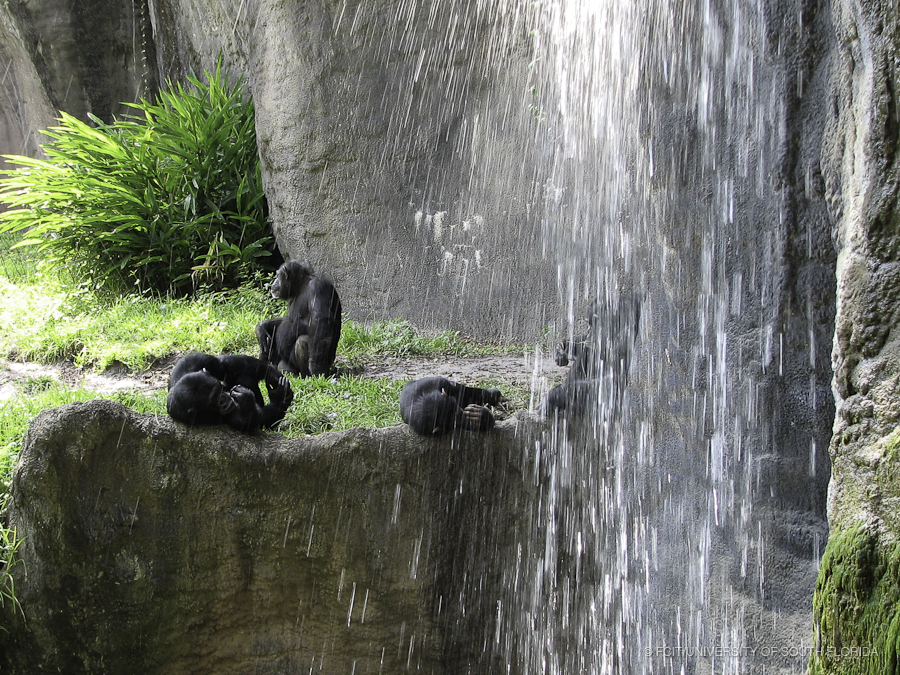
        We may never know for sure the origin and need for wonder in the human species, but we do know that it comes from a long way back.  Jane Goodall was observing her chimpanzees in Gombe when she noticed a male chimp gesturing excitedly at a beautiful waterfall. He perched on a nearby rock and gaped at the flowing torrents of water for a good 10 minutes.  Goodall and her team saw such responses on several occasions. She concluded that chimps have a sense of wonder, even speculating about a nascent form of spirituality in our simian cousins.

            Wonder helps us connect 
with that which is good.  Wonder, like other emotions, evolved as a motivator to help us move towards satisfaction or benefit, and away from discomfort or harm.      It balances with the other emotions.  The classic example is of a bear, at least classic for those of us who lived in Alaska where all life can be distilled down to bear stories or metaphors.   Wonder draws us to the woods in hopes of seeing a bear, and fear keeps our distance. Too much fear and we never go out, too much wonder and we are lunch. Wonder tempered with all our other emotional tools asks us to take a middle way - to get out and take some risks, but not overly so.

            With wonder open, we connect, and life's possibilities open before us.  Wonder helps us engage with the world to live in ways that integrate the reality that beauty is ever present. It also helps us face the also true, but harsher reality of harm, illness, death, disappointment, and massive suffering. Without wonder, we risk closing off to life, living more shallow lives, less intimacy and vibrancy. 


            One study showed how wonder opens us up.  In the study, they took teenagers rafting. A
week later they report being more engaged and curious about the world.      Wonder also  lifts depression, and in one study showed people to have less inflammation as measured in saliva.  It helps our prosocial behaviors - we become more empathetic, humble, and generous.  When we have more empathy, others resonate with us better and we have improved relationships.  Our self identity moves from a separate self to being part of a whole, or the whole itself.  By merely writing about awe, we become kinder, more compassionate, and this can extend to other species and the biotic community as a whole.

            I lead Nurture Nature workshops and retreats where we look out how we have choice in moving towards that which is good for us and others.  How can we nurture human nature so that we can nurture all of nature, I believe an important question in this time of climate change, loss of biodiversity, extinction, and factory farming.  Two primary aspects of human nature we nurture is wonder and its partner, empathy.  There are many ways to nurture wonder, as Rumi wrote:  "Let the beauty we are be what we do, there are hundreds of ways to kneel and kiss the ground."


            In Part 3 I will describe the first of four ways to  nurture our wonder.